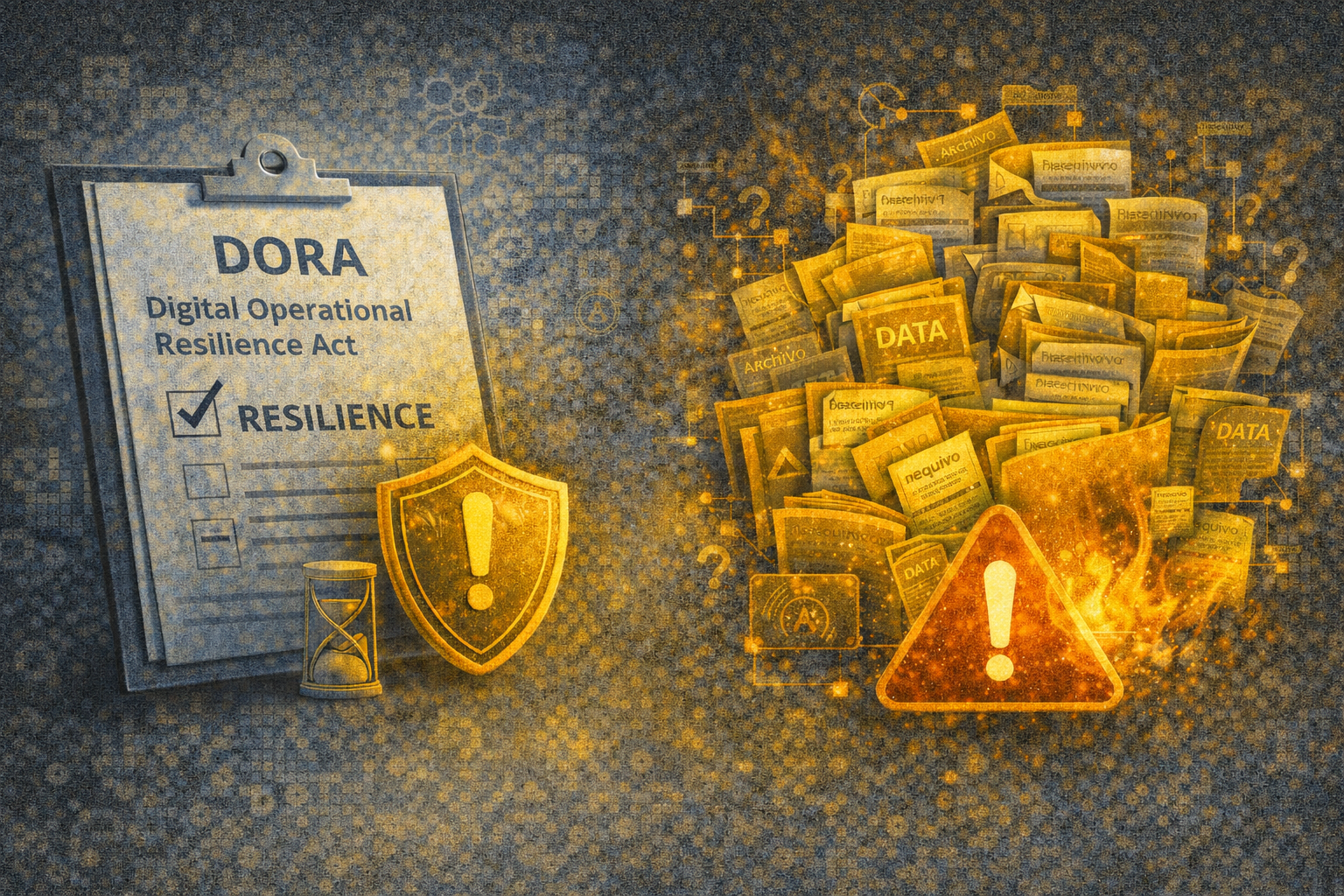
DORA suele entrar en las conversaciones con un foco muy comprensible: resiliencia operativa digital, terceros TIC, incidentes, pruebas y continuidad. Pero hay una lectura que muchas organizaciones todavía no aterrizan con suficiente profundidad: cuando una norma exige resiliencia operativa digital, el dato desordenado y la información opaca también se convierten en riesgo operativo.
No porque DORA sea una norma de gestión documental, sino porque la resiliencia también falla cuando la organización no sabe con rapidez qué activo importa, qué versión es válida, qué dependencia estaba en juego o qué flujo sostenía realmente el proceso afectado.
La consecuencia es simple y dura a la vez: si en un incidente no puedes reconstruir con claridad qué estaba operando, dónde estaba la información válida y qué tercero o sistema formaba parte del circuito crítico, tu problema ya no es solo técnico. Es operacional.
Por qué DORA empuja esta lectura
El Reglamento aplica desde el 17 de enero de 2025 y exige capacidades sólidas de gestión del riesgo TIC, reporte, pruebas y gestión del riesgo asociado a terceros. Eso obliga a mirar más allá del perímetro clásico. La empresa necesita saber qué elementos sostienen realmente su operación digital.
En ese marco, la opacidad informacional deja de parecer un problema menor. Si un proceso depende de documentos dispersos, versiones no reconciliadas, ownership dudoso o repositorios paralelos, la resiliencia de la respuesta se debilita. No por una carencia jurídica abstracta, sino por una dificultad muy concreta para entender y recomponer la realidad operativa.
- La resiliencia exige visibilidad, no solo protección.
- La recuperación exige claridad sobre la versión válida.
- La coordinación con terceros exige contexto compartible.
- La explicación posterior exige trazabilidad.
Dónde aparece el riesgo silencioso
Aparece cuando una incidencia obliga a varias áreas a buscar a la vez qué archivo manda, qué entorno estaba activo, qué proveedor tocaba ese tramo o qué salida era la operativa. Aparece cuando legal, operaciones, tecnología y negocio discuten desde realidades documentales distintas. Aparece cuando la organización puede tener sistemas muy sofisticados, pero no un conocimiento suficientemente coherente de su propio estado.
En ese punto, el desorden ya no es un inconveniente administrativo. Es una debilidad estructural de respuesta.
- Más tiempo para entender el incidente.
- Más fricción para priorizar y decidir.
- Más dificultad para coordinar terceros y evidencias.
- Más riesgo de recuperar sobre una base parcial o equivocada.
Qué lectura debería hacer el comité
La lectura madura de DORA no es que ahora haga falta “más compliance”. Es que el estándar de gobierno operativo sube. Y eso obliga a dejar de trivializar la calidad del mapa informacional que sostiene la operación.
No se trata de prometer control absoluto. Se trata de reconocer que la resiliencia real empieza antes del incidente, en la capacidad de ver, explicar y reconstruir el estado de la operación con suficiente rigor.
- DORA no pregunta solo si proteges.
- DORA obliga a pensar si entiendes lo que protege tu operación.
- Y si puedes demostrarlo cuando el sistema deja de comportarse como esperabas.
DORA often enters conversations with a very understandable focus: digital operational resilience, third-party ICT, incidents, testing, and continuity. But there is a reading that many organizations still do not grasp with sufficient depth: when a regulation requires digital operational resilience, disordered data and opaque information also become operational risks.
Not because DORA is a document management regulation, but because resilience also fails when the organization does not quickly know which asset matters, which version is valid, what dependency was at play, or what flow was actually sustaining the affected process.
The consequence is simple and harsh at the same time: if in an incident you cannot clearly reconstruct what was operating, where the valid information was, and which third party or system was part of the critical circuit, your problem is no longer just technical. It is operational.
Why DORA pushes this reading
The Regulation applies from January 17, 2025, and requires solid ICT risk management capabilities, reporting, testing, and management of risks associated with third parties. This forces a look beyond the classic perimeter. The company needs to know what elements truly support its digital operation.
In this framework, informational opacity ceases to seem like a minor problem. If a process depends on scattered documents, un-reconciled versions, questionable ownership, or parallel repositories, the resilience of the response weakens. Not due to an abstract legal deficiency, but because of a very concrete difficulty in understanding and reconstructing the operational reality.
- Resilience requires visibility, not just protection.
- Recovery requires clarity about the valid version.
- Coordination with third parties requires shareable context.
- Subsequent explanation requires traceability.
Where silent risk appears
It appears when an incident forces several areas to simultaneously search for which file is authoritative, what environment was active, which provider was involved in that segment, or what output was operational. It appears when legal, operations, technology, and business discuss from different documentary realities. It appears when the organization may have very sophisticated systems but lacks a sufficiently coherent understanding of its own state.
At that point, disorder is no longer an administrative inconvenience. It is a structural weakness of response.
- More time to understand the incident.
- More friction to prioritize and decide.
- More difficulty in coordinating third parties and evidence.
- More risk of recovering on a partial or incorrect basis.
What reading should the committee make
The mature reading of DORA is not that “more compliance” is now needed. It is that the standard of operational governance is raised. And that forces a stop to trivializing the quality of the informational map that supports the operation.
This is not about promising absolute control. It is about recognizing that real resilience starts before the incident, in the ability to see, explain, and reconstruct the state of the operation with sufficient rigor.
- DORA does not just ask if you protect.
- DORA forces you to think if you understand what protects your operation.
- And if you can demonstrate it when the system stops behaving as you expected.