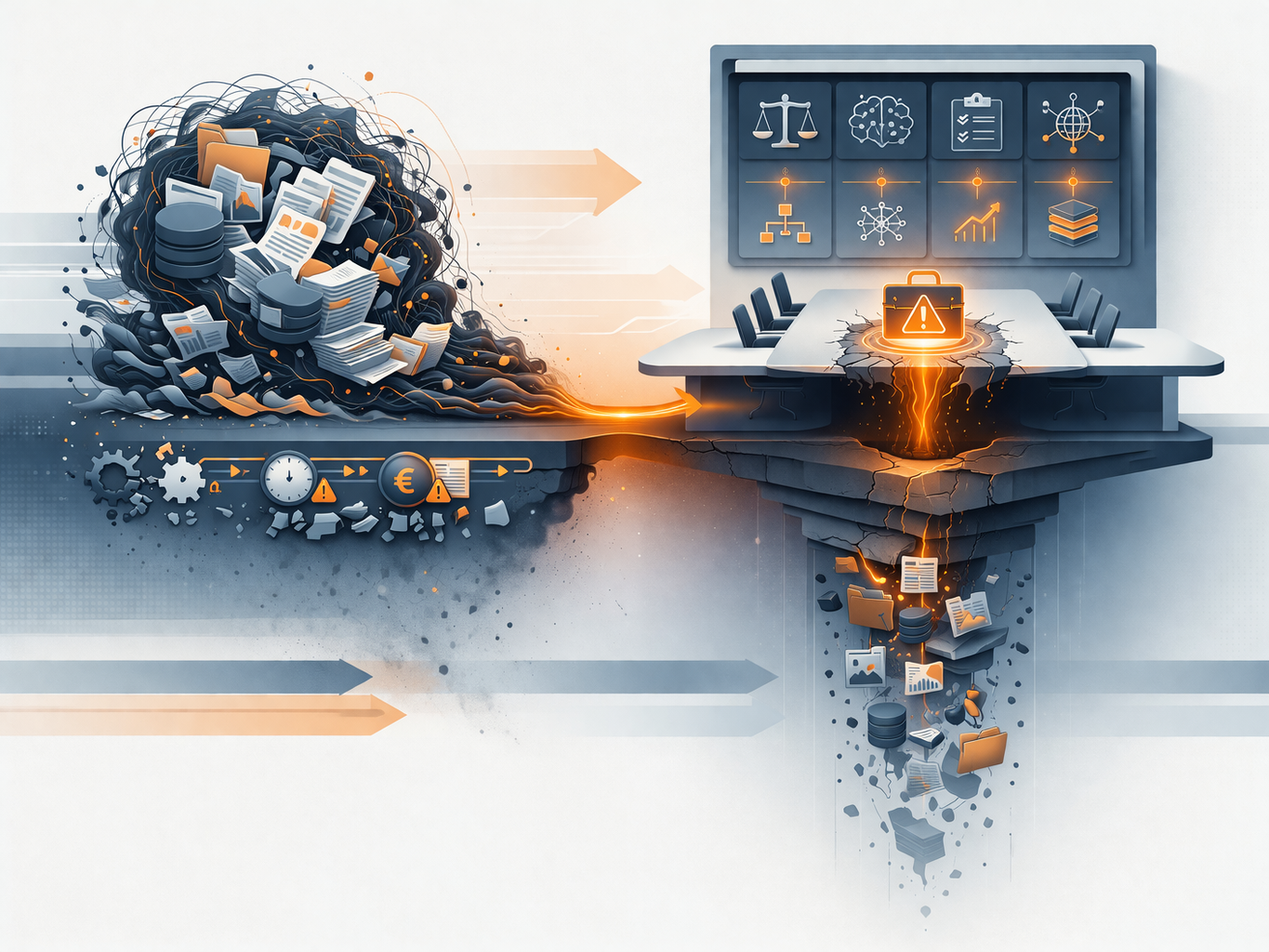
Durante anos el dato desordenado ha sido tratado como una molestia operativa. Hace perder tiempo, genera retrabajo, alarga reuniones, complica validaciones y desgasta a quienes dependen de versiones, historicos y repositorios dispersos. Ese coste sigue existiendo. Pero ya no es suficiente describir el problema asi. En 2026, el dato desordenado empieza a tener una relevancia mas alta: se esta convirtiendo en pasivo de direccion.
La razon es sencilla. Cada vez mas decisiones, obligaciones y exposiciones dependen de la capacidad de la empresa para saber que informacion existe, cual es la valida, donde esta, quien responde por ella y como se conecta con operaciones, terceros, productos o procesos de IA. Cuando esa claridad falla, el impacto ya no queda encerrado en el equipo que busca un archivo. Sube a supervision, riesgo, cumplimiento y credibilidad ante direccion.
Por que cambia de rango
El contexto regulatorio ayuda a entenderlo. NIS2, DORA, CRA, AI Act y Data Act no hablan todas del mismo problema, pero si comparten una exigencia de fondo: comprender mejor el ecosistema real para poder gestionar riesgo, reportar, supervisar y responder con evidencia. Eso convierte el desorden informacional en algo mas serio que una ineficiencia local.
- Si no se sabe que version manda, la operacion decide peor.
- Si no se entiende que dependencia sostiene un proceso, la continuidad se degrada.
- Si no se puede trazar el uso real de IA, el gobierno queda debilitado.
- Si no se conoce el estado real del dato, la direccion supervisa sobre percepciones y no sobre hechos.
Ese ultimo punto es el mas delicado. Un pasivo de direccion no es solo un problema caro. Es un problema que condiciona la capacidad de decidir con confianza, priorizar con criterio y demostrar control cuando alguien relevante lo exige.
No es solo una cuestion de orden
El error seria reducir esto a higiene documental. No se trata unicamente de tener carpetas mas limpias o nombres mas consistentes. Se trata de gobierno. De ownership. De trazabilidad. De capacidad de saber donde esta la realidad operativa sobre la que se apoya el negocio. En un entorno donde la empresa quiere automatizar mas, usar mas IA y responder mejor a exigencias regulatorias, ese suelo se vuelve irrenunciable.
Concluson
El dato desordenado ya no es solo ineficiencia. Se esta convirtiendo en pasivo de direccion. Porque erosiona la capacidad de supervision, reduce la calidad del criterio ejecutivo y debilita la posibilidad de probar que el riesgo se entiende y se gestiona. Esa es la razon por la que el problema ya no puede quedarse en backoffice. Ha subido al nivel donde se decide de verdad.
For years, disorganized data has been treated as an operational nuisance. It wastes time, generates rework, prolongs meetings, complicates validations, and exhausts those who depend on versions, historical data, and scattered repositories. This cost still exists. But it is no longer sufficient to describe the problem this way. In 2026, disorganized data begins to have a higher relevance: it is becoming a management liability.
The reason is simple. More and more decisions, obligations, and exposures depend on the company's ability to know what information exists, which is valid, where it is, who is responsible for it, and how it connects with operations, third parties, products, or AI processes. When that clarity fails, the impact is no longer confined to the team searching for a file. It escalates to supervision, risk, compliance, and credibility before management.
Why it changes in importance
The regulatory context helps to understand this. NIS2, DORA, CRA, AI Act, and Data Act do not all address the same problem, but they do share a fundamental requirement: to better understand the real ecosystem in order to manage risk, report, supervise, and respond with evidence. This turns informational disorder into something more serious than a local inefficiency.
- If the governing version is unknown, operations make worse decisions.
- If the dependency supporting a process is not understood, continuity degrades.
- If the actual use of AI cannot be traced, governance is weakened.
- If the real state of the data is unknown, management supervises based on perceptions rather than facts.
This last point is the most delicate. A management liability is not just an expensive problem. It is a problem that conditions the ability to decide with confidence, prioritize with criteria, and demonstrate control when someone relevant demands it.
It is not just a matter of order
The mistake would be to reduce this to document hygiene. It is not just about having cleaner folders or more consistent names. It is about governance. About ownership. About traceability. About the ability to know where the operational reality that supports the business is located. In an environment where the company wants to automate more, use more AI, and respond better to regulatory demands, this foundation becomes indispensable.
Conclusion
Disorganized data is no longer just inefficiency. It is becoming a management liability. Because it erodes the capacity for supervision, reduces the quality of executive judgment, and weakens the ability to prove that risk is understood and managed. That is why the problem can no longer remain in the back office. It has risen to the level where real decisions are made.