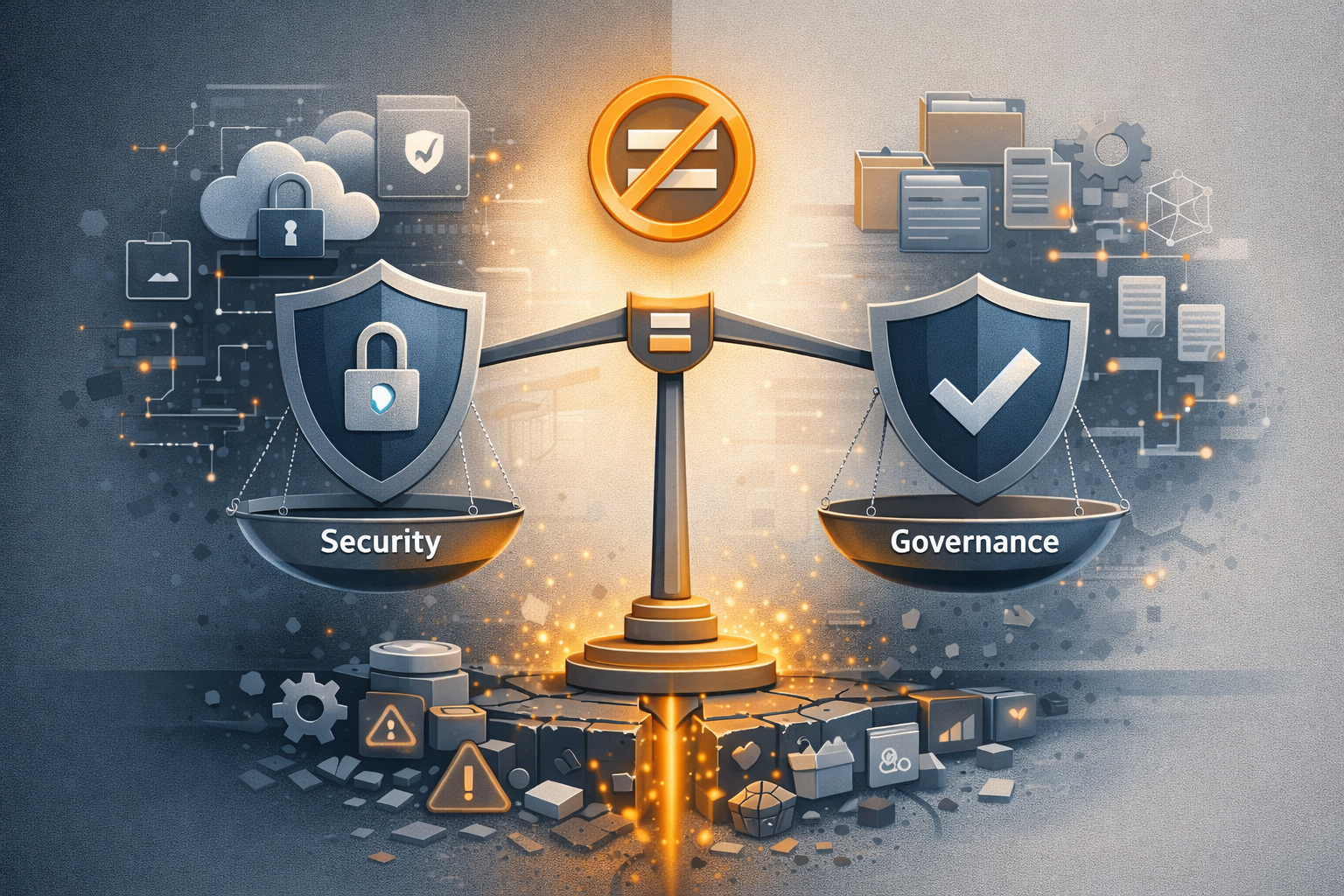
Uno de los errores mas persistentes del discurso corporativo actual es tratar seguridad y gobierno como si fueran casi sinonimos. La organizacion invierte en herramientas de proteccion, despliega deteccion, refuerza respuesta y concluye que esta gobernando mejor su realidad digital. Esa conclusion es comprensible, pero incorrecta.
La seguridad cumple una funcion imprescindible: proteger activos, detectar amenazas, responder a incidentes, reducir superficie de exposicion y fortalecer resiliencia tecnica. Pero el gobierno cumple otra funcion distinta y complementaria: asignar contexto, ownership, ciclo de vida, criterio, trazabilidad y capacidad de prueba sobre la realidad operativa. Sin ese plano, la seguridad puede ser razonablemente fuerte y aun asi operar sobre un conocimiento parcial del entorno.
Por que la confusion es tan costosa
La confusion sale cara porque da una sensacion prematura de control. Si la empresa cree que tener seguridad suficiente equivale a gobernar bien, dejara sin resolver preguntas mucho mas basicas y determinantes.
- Que activos y servicios sostienen la operacion real.
- Que version o documento es el valido.
- Que dependencias externas condicionan la continuidad.
- Que usos de IA ya operan informalmente.
- Que parte del ecosistema sigue fuera de radar o sin ownership claro.
Ese vacio no desaparece porque exista un firewall, un EDR o un buen SOC. La seguridad puede defender mejor lo que ve. El gobierno ayuda a decidir que existe, que importa y como debe interpretarse esa realidad.
La regulacion lo esta haciendo evidente
NIS2, CRA, DORA y la AI Act no empujan solo a proteger. Empujan a comprender, supervisar, reportar, asignar responsabilidades y poder demostrar con evidencia como se gestiona el riesgo. Ese salto no es solo de ciberseguridad. Es de gobierno digital. Y ahi se ve con claridad por que la ecuacion seguridad = gobierno se queda corta.
La seguridad sigue siendo indispensable. Pero una organizacion que confunde ambas cosas terminara descubriendo que puede proteger relativamente bien sin entender del todo aquello que sostiene su operacion. Y cuando llegue una auditoria, un incidente grave, una exigencia regulatoria o una cadena de suministro fallida, esa diferencia se vuelve visible muy rapido.
Concluson
El error del mercado no esta en valorar la seguridad. Esta en convertirla en sustituto de algo que no puede reemplazar. La seguridad protege. El gobierno permite comprender, asignar, demostrar y decidir. Las empresas que sigan confundiendo ambas dimensiones podran tener mas tecnologia y, aun asi, seguir sin conocer con suficiente precision la realidad sobre la que operan.
One of the most persistent errors in current corporate discourse is treating security and governance as if they were almost synonymous. The organization invests in protection tools, deploys detection, strengthens response, and concludes that it is governing its digital reality better. That conclusion is understandable, but incorrect.
Security serves an essential function: protecting assets, detecting threats, responding to incidents, reducing exposure surface, and strengthening technical resilience. But governance serves a distinct and complementary function: assigning context, ownership, lifecycle, criteria, traceability, and the ability to prove the operational reality. Without that framework, security can be reasonably strong and still operate on a partial understanding of the environment.
Why the confusion is so costly
The confusion is costly because it gives a premature sense of control. If the company believes that having sufficient security equates to good governance, it will leave much more basic and determining questions unresolved.
- What assets and services support the actual operation.
- Which version or document is the valid one.
- What external dependencies condition continuity.
- What uses of AI are already operating informally.
- What part of the ecosystem remains off the radar or without clear ownership.
That void does not disappear because there is a firewall, an EDR, or a good SOC. Security can better defend what it sees. Governance helps decide what exists, what matters, and how that reality should be interpreted.
Regulation is making it evident
NIS2, CRA, DORA, and the AI Act do not only push for protection. They push for understanding, supervising, reporting, assigning responsibilities, and being able to demonstrate with evidence how risk is managed. That leap is not just about cybersecurity. It is about digital governance. And it clearly shows why the equation security = governance falls short.
Security remains indispensable. But an organization that confuses both will ultimately discover that it can protect relatively well without fully understanding what supports its operation. And when an audit, a serious incident, a regulatory requirement, or a failed supply chain arrives, that difference becomes visible very quickly.
Conclusion
The market's error is not in valuing security. It is in turning it into a substitute for something it cannot replace. Security protects. Governance allows for understanding, assigning, demonstrating, and deciding. Companies that continue to confuse both dimensions may have more technology and still fail to know with sufficient precision the reality on which they operate.