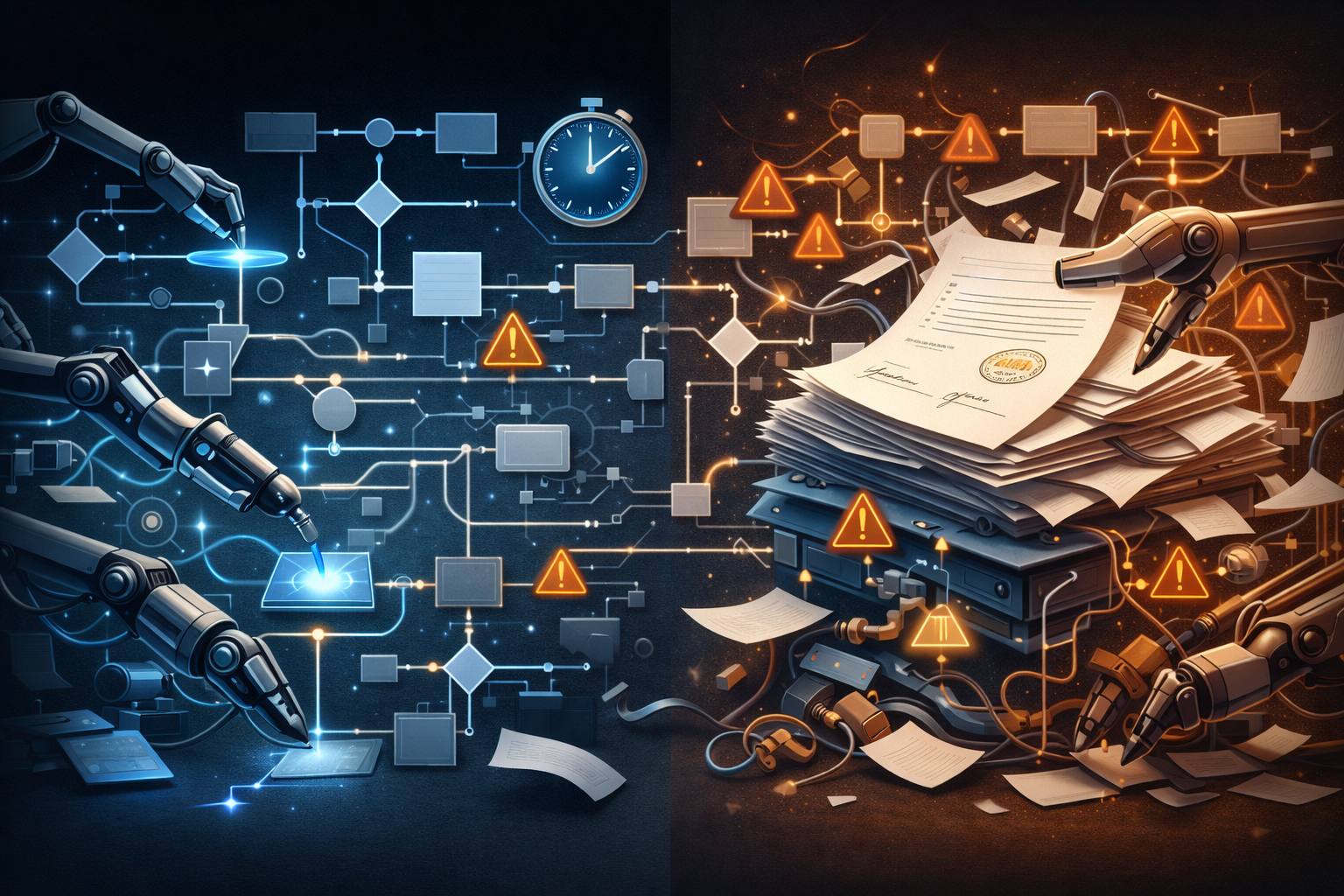
2026 corre el riesgo de consolidar un error conceptual muy serio: confundir más automatización con más control. La confusión es tentadora porque la automatización sí puede reducir tiempos, tareas repetitivas y carga humana. El problema es que ninguna de esas mejoras equivale por sí misma a conocimiento real del ecosistema ni a gobierno maduro.
De hecho, en algunos contextos ocurre lo contrario. Cuanto más automatizada está una organización sobre una base poco visible, más rápido puede escalar una decisión mal contextualizada, una versión errónea, una dependencia no entendida o un flujo opaco.
Por eso la conversación no debería ser si automatizar o no automatizar. Debería ser sobre qué base de realidad visible y de control contextual se automatiza.
Qué sí aporta la automatización y qué no aporta sola
La automatización aporta velocidad, consistencia en tareas repetibles y capacidad de liberar tiempo humano. Es valiosa. Sería absurdo negarlo. Lo que no aporta por sí sola es comprensión del sistema, calidad del contexto, certeza sobre ownership o capacidad de reconstrucción de la realidad cuando algo sale mal.
McKinsey y NIST convergen en un punto útil: el valor de la IA y de las automatizaciones avanzadas depende de prácticas de gestión, validación, modelo operativo, datos y gobierno. El rendimiento no nace solo del acceso a tecnología.
- La automatización no sustituye inventario.
- La automatización no crea ownership automáticamente.
- La automatización no corrige una versión equivocada si no sabe distinguirla.
- La automatización no convierte la opacidad en trazabilidad.
Dónde nace la falsa sensación de control
Nace cuando un proceso 'ya corre solo' y eso se interpreta como madurez. Nace cuando se confunde menos intervención humana con mejor gobierno. Nace cuando dirección ve más flujo y más rapidez, pero no necesariamente más capacidad de explicar cómo funciona de verdad lo que está ocurriendo.
Esta falsa sensación es especialmente peligrosa en entornos donde ya existían silos, duplicidad, ownership dudoso o usos no inventariados de IA. La automatización puede maquillar durante un tiempo esas debilidades. No las elimina.
- Más flujo no es más claridad.
- Más autonomía no es más criterio.
- Más integración no es más verdad operativa.
- Más outputs no son más control.
La lectura responsable para 2026
La lectura responsable no es frenar la automatización. Es exigirle más. Exigirle contexto, límites, trazabilidad, criterios de supervisión y una base de información menos ingenua. El objetivo no es automatizar menos, sino automatizar mejor y sobre una realidad más visible.
Quien entienda esto antes cometerá menos errores de diseño y menos errores de relato. Porque podrá decir con más honestidad qué parte de su operación está realmente bajo control y qué parte solo parece estarlo.
- El gran error de 2026 no será automatizar.
- Será automatizar creyendo que eso ya equivale a gobernar.
2026 runs the risk of consolidating a very serious conceptual error: confusing more automation with more control. The confusion is tempting because automation can indeed reduce time, repetitive tasks, and human workload. The problem is that none of those improvements equate on their own to real knowledge of the ecosystem or mature governance.
In fact, in some contexts, the opposite occurs. The more automated an organization is based on a poorly visible foundation, the faster a poorly contextualized decision, an erroneous version, an ununderstood dependency, or an opaque flow can scale.
That is why the conversation should not be about whether to automate or not. It should be about what visible reality and contextual control is being automated.
What automation does contribute and what it does not contribute on its own
Automation contributes speed, consistency in repeatable tasks, and the ability to free up human time. It is valuable. It would be absurd to deny it. What it does not contribute on its own is understanding of the system, quality of context, certainty about ownership, or the ability to reconstruct reality when something goes wrong.
McKinsey and NIST converge on a useful point: the value of AI and advanced automation depends on management practices, validation, operating model, data, and governance. Performance does not arise solely from access to technology.
- Automation does not replace inventory.
- Automation does not automatically create ownership.
- Automation does not correct an erroneous version if it cannot distinguish it.
- Automation does not turn opacity into traceability.
Where the false sense of control originates
It originates when a process 'runs on its own' and this is interpreted as maturity. It originates when less human intervention is confused with better governance. It originates when management sees more flow and more speed, but not necessarily more capacity to explain how what is really happening works.
This false sense is especially dangerous in environments where there were already silos, duplication, questionable ownership, or unaccounted uses of AI. Automation can temporarily mask those weaknesses. It does not eliminate them.
- More flow is not more clarity.
- More autonomy is not more judgment.
- More integration is not more operational truth.
- More outputs are not more control.
The responsible reading for 2026
The responsible reading is not to halt automation. It is to demand more from it. To demand context, limits, traceability, oversight criteria, and a less naive information base. The goal is not to automate less, but to automate better and based on a more visible reality.
Those who understand this will make fewer design mistakes and fewer narrative errors. Because they will be able to more honestly state which part of their operation is truly under control and which part only seems to be.
- The great mistake of 2026 will not be to automate.
- It will be to automate believing that this already equates to governing.