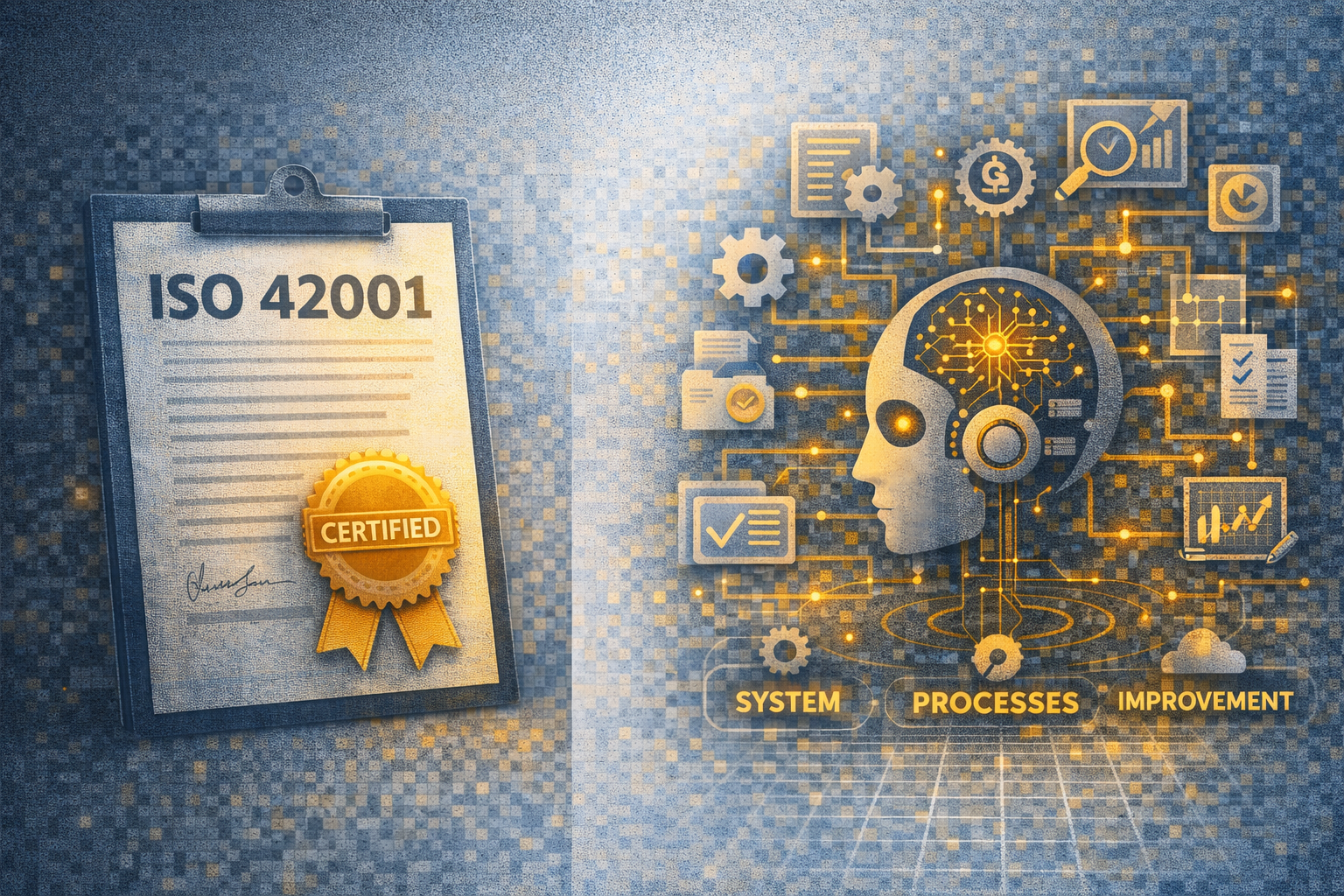
ISO 42001 está entrando en muchas conversaciones como si fuera una nueva casilla de compliance. Esa lectura es demasiado pobre. Lo relevante de ISO 42001 no es el brillo del certificado, sino el cambio de madurez que representa.
ISO presenta ISO/IEC 42001 como la primera norma mundial sobre sistemas de gestión de IA. No la define como una guía inspiracional ni como una recomendación suelta. La define como un estándar para establecer, implementar, mantener y mejorar continuamente un sistema de gestión de IA dentro del contexto de una organización. Ese lenguaje importa mucho más de lo que parece.
Cuando una norma define la IA como materia de sistema de gestión, la empresa deja de poder tratarla como una suma dispersa de pilotos, herramientas brillantes y decisiones aisladas. La IA ya no cabe en una policy general, una presentación de principios o un comité que se reúne de vez en cuando. Exige estructura.
Qué aporta realmente ISO 42001
La norma aporta una lógica de sistema. Eso significa disciplina de procesos, revisión, mejora continua, clarificación de roles y tratamiento explícito de riesgos y oportunidades. También aporta un puente cultural importante: traduce la conversación sobre IA al lenguaje que dirección, auditoría y gobierno corporativo ya entienden mejor.
ISO insiste además en que el estándar sirve para organizaciones que desarrollan, proveen o usan sistemas de IA. Es decir, no queda restringido al gran laboratorio que construye modelos. También interpela a la empresa que despliega, integra o depende de la IA en su operación.
- Introduce disciplina de procesos, no solo declaraciones de intención.
- Empuja a clarificar roles, riesgos, controles y mejora continua.
- Conecta innovación con gobernanza en lugar de tratarlas como polos opuestos.
- Acerca la IA al lenguaje de sistema, evidencia y revisión.
Lo que no debería prometerse
ISO 42001 no garantiza por sí sola que todos los modelos sean fiables, que no existan riesgos o que la organización controle absolutamente todo lo relacionado con IA. Tampoco sustituye la necesidad de validar outputs, gestionar terceros, revisar contexto o limitar usos cuando la situación lo exige.
NIST AI RMF es útil precisamente para recordar esto. Su enfoque voluntario sobre gestión del riesgo de IA parte de que la confianza no se obtiene por declaración, sino por una combinación de gobierno, contexto, medición y gestión continua. Una certificación no elimina la necesidad de criterio.
- No elimina inexactitud, sesgos o riesgos de terceros por arte de magia.
- No sustituye el juicio humano ni la validación contextual.
- No convierte a una empresa en madura si su uso real de IA sigue siendo opaco.
- No resuelve por sí sola problemas de inventario, ownership o trazabilidad.
Por qué encaja con FORENSE
Porque el salto que introduce ISO 42001 es el mismo que vemos emerger en todo el mercado: pasar de discurso a sistema. Y un sistema serio necesita inventario, trazabilidad, ownership, evidencias y capacidad de demostrar cómo y dónde se usa la IA de verdad.
La pregunta ya no es si tienes política de IA. La pregunta es si tienes sistema, realidad visible y capacidad de prueba.
- ISO 42001 no debería venderse como trofeo.
- Debería leerse como síntoma de una etapa nueva.
- Una etapa en la que la IA ya no puede gobernarse desde la improvisación.
ISO 42001 is entering many conversations as if it were a new compliance checkbox. That reading is too simplistic. The relevance of ISO 42001 is not the shine of the certificate, but the maturity change it represents.
ISO presents ISO/IEC 42001 as the first global standard on AI management systems. It does not define it as an inspirational guide or a loose recommendation. It defines it as a standard for establishing, implementing, maintaining, and continually improving an AI management system within the context of an organization. That language matters much more than it seems.
When a standard defines AI as a matter of management system, the company can no longer treat it as a scattered sum of pilots, brilliant tools, and isolated decisions. AI can no longer fit into a general policy, a principles presentation, or a committee that meets occasionally. It demands structure.
What ISO 42001 Really Brings
The standard brings a system logic. That means process discipline, review, continuous improvement, clarification of roles, and explicit treatment of risks and opportunities. It also provides an important cultural bridge: it translates the conversation about AI into the language that management, auditing, and corporate governance already understand better.
ISO also insists that the standard serves organizations that develop, provide, or use AI systems. That is, it is not restricted to the large laboratory that builds models. It also addresses the company that deploys, integrates, or depends on AI in its operations.
- It introduces process discipline, not just statements of intent.
- It pushes for clarification of roles, risks, controls, and continuous improvement.
- It connects innovation with governance instead of treating them as opposing poles.
- It brings AI closer to the language of systems, evidence, and review.
What Should Not Be Promised
ISO 42001 does not guarantee on its own that all models are reliable, that there are no risks, or that the organization controls absolutely everything related to AI. It also does not replace the need to validate outputs, manage third parties, review context, or limit uses when the situation requires it.
NIST AI RMF is useful precisely to remind us of this. Its voluntary approach to AI risk management starts from the premise that trust is not obtained by declaration, but by a combination of governance, context, measurement, and continuous management. A certification does not eliminate the need for judgment.
- It does not magically eliminate inaccuracies, biases, or third-party risks.
- It does not replace human judgment or contextual validation.
- It does not make a company mature if its actual use of AI remains opaque.
- It does not solve inventory, ownership, or traceability issues on its own.
Why It Fits with FORENSE
Because the leap introduced by ISO 42001 is the same as the one we see emerging throughout the market: moving from discourse to system. And a serious system needs inventory, traceability, ownership, evidence, and the ability to demonstrate how and where AI is truly used.
The question is no longer whether you have an AI policy. The question is whether you have a system, visible reality, and proof capability.
- ISO 42001 should not be sold as a trophy.
- It should be read as a symptom of a new stage.
- A stage in which AI can no longer be governed from improvisation.