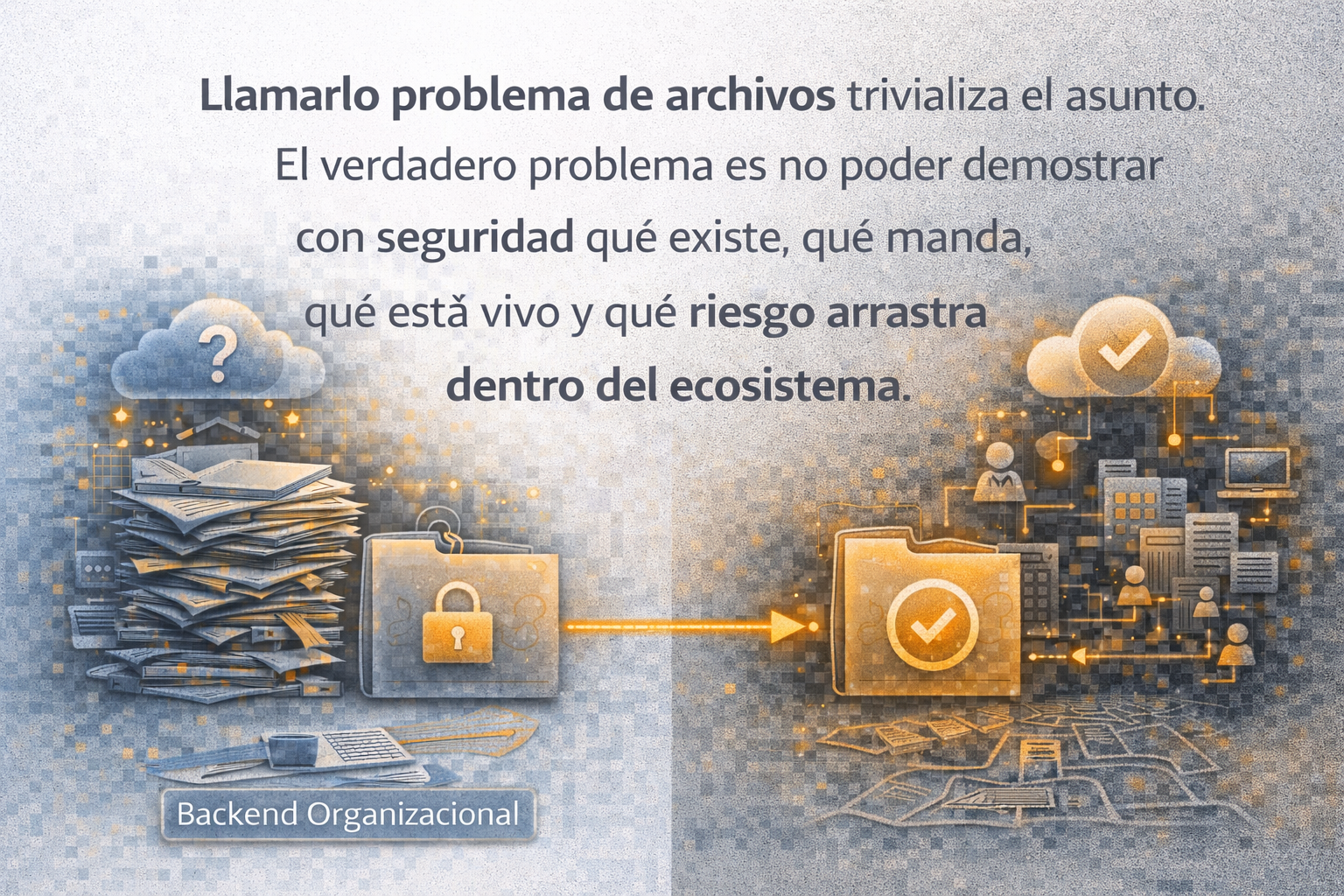
Muchas empresas explican su dolor digital con una palabra que se queda pequeña: archivos. Dicen que tienen demasiados archivos, demasiadas carpetas, demasiadas copias, demasiada dispersión documental. Todo eso puede ser cierto. Pero a menudo describe la superficie, no el núcleo del problema.
El problema de fondo suele ser otro: la organización no puede demostrar con suficiente claridad el estado real de su ecosistema digital. No sabe con precisión suficiente qué existe, qué manda, qué está duplicado, qué está huérfano, qué depende de quién y qué parte de la operación descansa sobre información que nadie ve del todo bien.
Cuando se entiende esto, la conversación cambia. Ya no se trata solo de ordenar archivos. Se trata de construir una capacidad de realidad visible.
Por qué llamar 'problema de archivos' a todo esto es insuficiente
Porque hace pensar que la dificultad es principalmente volumétrica o estética. Como si el problema fuera que hay demasiado contenido y no que falta una capa coherente de ownership, criterio y trazabilidad. Ordenar contenedores puede ayudar. Pero si el estado real sigue opaco, el problema se reconfigura y reaparece.
Además, hablar de archivos invisibiliza otras capas: servicios, versiones, automatizaciones, dependencias, productos con elementos digitales, flujos de IA, repositorios paralelos y zonas de negocio que operan con su propio mapa.
- No es solo volumen.
- No es solo nomenclatura.
- No es solo limpieza de carpetas.
- Es una cuestión de verdad operativa.
Qué significa trabajar sobre estado real
Significa tratar la realidad del ecosistema como un objeto de conocimiento y no solo como una suma de contenedores. Significa inventariar, comparar, entender ownership, detectar duplicidad, localizar zonas opacas y ser capaz de responder con una sola realidad defendible cuando alguien pregunta qué existe de verdad.
Ese tipo de capacidad cambia la calidad de decisiones mucho más que una reorganización cosmética del árbol de carpetas.
- Permite priorizar mejor.
- Permite discutir con comité con menos relato y más evidencia.
- Permite absorber mejor IA y automatización.
- Permite reducir el espacio entre percepción de orden y control real.
Qué gana una empresa cuando cambia el marco mental
Gana un diagnóstico más útil. Deja de pensar que el problema está en el síntoma visible y empieza a trabajar sobre la estructura que lo produce. Eso permite decidir mejor qué herramientas sobran, cuáles faltan, qué procesos necesitan depuración y qué zonas del ecosistema merecen una auditoría más seria.
La madurez empieza cuando la empresa deja de tener solo un problema de archivos y acepta que lo que realmente necesita es menos ficción y más estado real.
- Archivos hay en todas partes.
- Lo raro no es tener muchos.
- Lo raro y valioso es poder explicar qué representan, cuál vale y qué riesgo arrastran.
Many companies explain their digital pain with a word that falls short: files. They say they have too many files, too many folders, too many copies, too much document dispersion. All of that may be true. But it often describes the surface, not the core of the problem.
The underlying issue is usually different: the organization cannot demonstrate with sufficient clarity the real state of its digital ecosystem. It does not know precisely enough what exists, what governs, what is duplicated, what is orphaned, what depends on whom, and what part of the operation rests on information that no one sees very clearly.
When this is understood, the conversation changes. It is no longer just about organizing files. It is about building a capability for visible reality.
Why calling this a 'file problem' is insufficient
Because it suggests that the difficulty is primarily volumetric or aesthetic. As if the problem were that there is too much content and not that there is a lack of a coherent layer of ownership, criteria, and traceability. Organizing containers can help. But if the real state remains opaque, the problem reconfigures and reappears.
Moreover, talking about files makes other layers invisible: services, versions, automations, dependencies, products with digital elements, AI flows, parallel repositories, and business areas that operate with their own map.
- It is not just volume.
- It is not just nomenclature.
- It is not just folder cleaning.
- It is a matter of operational truth.
What it means to work on real state
It means treating the reality of the ecosystem as an object of knowledge and not just as a sum of containers. It means inventorying, comparing, understanding ownership, detecting duplication, locating opaque areas, and being able to respond with a single defensible reality when someone asks what truly exists.
This type of capability changes the quality of decisions much more than a cosmetic reorganization of the folder tree.
- It allows for better prioritization.
- It allows for discussions with committees with less narrative and more evidence.
- It allows for better absorption of AI and automation.
- It reduces the gap between the perception of order and actual control.
What a company gains when it changes its mental framework
It gains a more useful diagnosis. It stops thinking that the problem lies in the visible symptom and starts working on the structure that produces it. This allows for better decisions on which tools are redundant, which are missing, which processes need refinement, and which areas of the ecosystem deserve a more serious audit.
Maturity begins when the company stops having just a file problem and accepts that what it really needs is less fiction and more real state.
- Files are everywhere.
- It is not unusual to have many.
- What is rare and valuable is being able to explain what they represent, which ones are valuable, and what risks they carry.