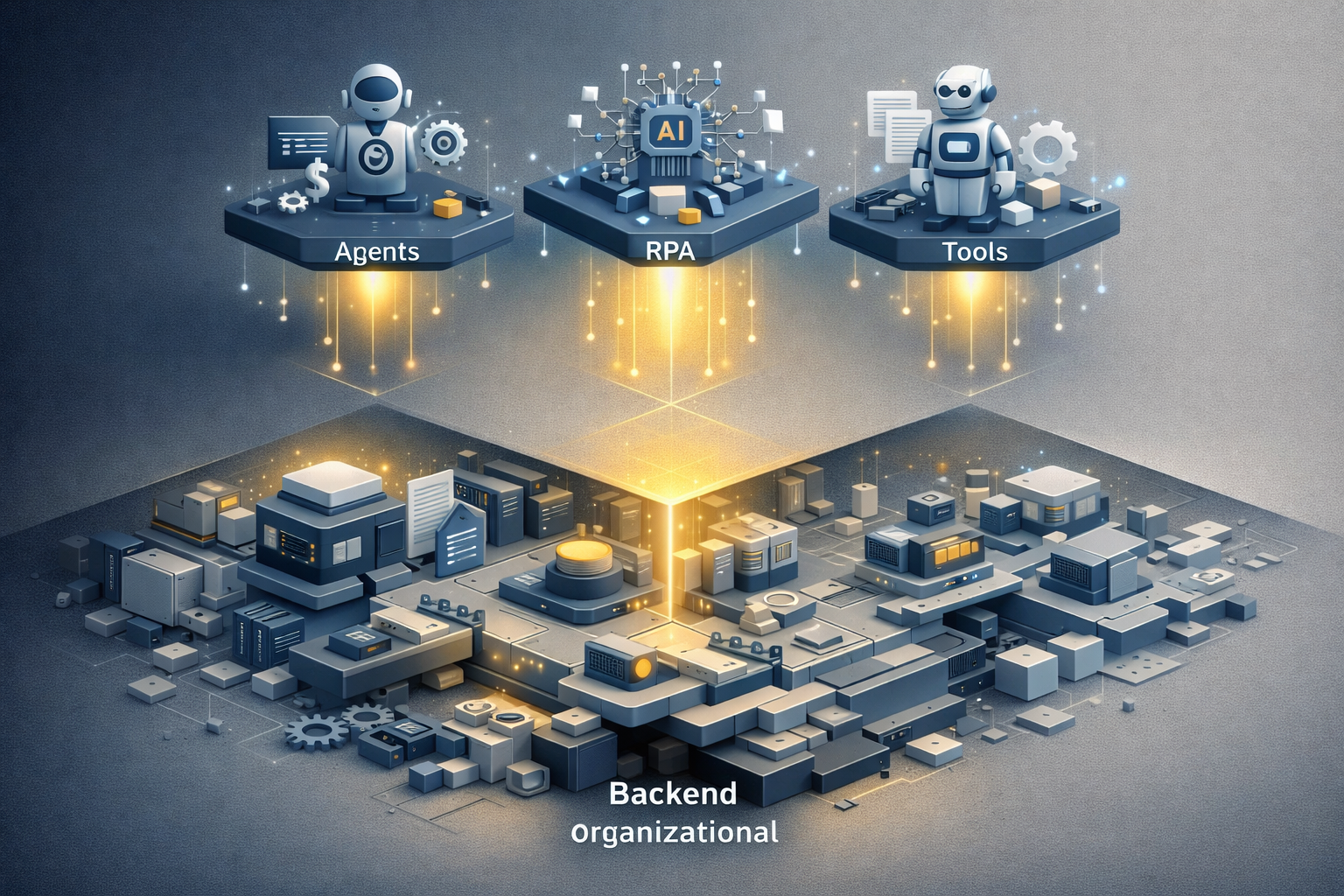
La palabra agente se ha convertido en uno de los grandes condensadores del entusiasmo tecnologico actual. Resume una promesa poderosa: sistemas capaces de planificar, actuar, coordinar tareas y ampliar de forma radical la capacidad de la empresa. La narrativa es tan atractiva que puede hacer parecer inevitable una conclusion: la organizacion que no se mueva rapido hacia agentes se quedara atras.
Hay una parte cierta en ese impulso. McKinsey muestra que el interes por la IA agentica esta creciendo y que las organizaciones siguen explorando como convertir la adopcion de IA en impacto real. Microsoft empuja la idea de la Frontier Firm y de la inteligencia disponible bajo demanda. Pero entre ese futuro y la realidad de la mayoria de empresas hay una capa intermedia que el mercado no esta contando con suficiente honestidad: muchas organizaciones todavia no han resuelto su backend organizacional.
Que significa backend organizacional
No se trata de una plataforma concreta. Se trata del conjunto de contexto, estructura y realidad operativa que permite que una accion automatizada tenga sentido y pueda ser supervisada despues. Incluye cosas muy poco glamourosas y por eso mismo muy decisivas.
- Que datos son validos y cuales no.
- Que version manda y quien responde por ella.
- Que procesos existen de verdad y no solo en el organigrama.
- Que dependencias sostienen la operacion.
- Que reglas, excepciones y criterios deben respetarse.
Sin esa capa, el agente no opera sobre empresa. Opera sobre una interpretacion incompleta de empresa.
La promesa se vuelve fragil sin mapa
Cuanto mas autonomia o capacidad de accion se quiera dar a un sistema, mas importante se vuelve la calidad del mapa sobre el que actua. NIST AI RMF ayuda a entenderlo bien: gobernar, mapear, medir y gestionar. La organizacion que pretende saltar directamente a la ejecucion automatizada sin haber hecho visible su realidad operativa convierte el entusiasmo en una fuente potencial de ruido y decisiones mal contextualizadas.
Por eso la pregunta madura no es “cuantos agentes podemos desplegar este ano”. La pregunta madura es “sobre que backend organizacional van a operar esos agentes, con que trazabilidad, con que capacidad de prueba y con que posibilidad real de correccion”.
Concluson
El mercado esta obsesionado con agentes. La empresa, en muchos casos, todavia no ha resuelto su backend organizacional. Esa no es una razon para frenar toda exploracion. Es una razon para colocar la prioridad en el sitio correcto. Antes de pedir mas autonomia a la IA, hace falta construir mas claridad sobre la realidad que esa IA debera interpretar y sobre la que, eventualmente, querra actuar.
The word agent has become one of the great condensers of current technological enthusiasm. It encapsulates a powerful promise: systems capable of planning, acting, coordinating tasks, and radically expanding the company's capacity. The narrative is so appealing that it can make one conclude inevitably: the organization that does not move quickly towards agents will be left behind.
There is a certain truth in that drive. McKinsey shows that interest in agentic AI is growing and that organizations continue to explore how to turn AI adoption into real impact. Microsoft promotes the idea of the Frontier Firm and on-demand intelligence. But between that future and the reality of most companies lies an intermediate layer that the market is not addressing with sufficient honesty: many organizations still have not resolved their organizational backend.
What does organizational backend mean
It is not about a specific platform. It is about the context, structure, and operational reality that allows an automated action to make sense and be supervised afterward. It includes very unglamorous things, and for that reason, very decisive ones.
- Which data is valid and which is not.
- Which version is authoritative and who is accountable for it.
- Which processes truly exist and are not just on the organizational chart.
- What dependencies sustain the operation.
- What rules, exceptions, and criteria must be respected.
Without that layer, the agent does not operate on the company. It operates on an incomplete interpretation of the company.
The promise becomes fragile without a map
The more autonomy or capacity for action one wants to give to a system, the more important the quality of the map it operates on becomes. NIST AI RMF helps to understand this well: govern, map, measure, and manage. The organization that intends to jump directly to automated execution without having made its operational reality visible turns enthusiasm into a potential source of noise and poorly contextualized decisions.
That is why the mature question is not “how many agents can we deploy this year.” The mature question is “on what organizational backend will those agents operate, with what traceability, with what testing capability, and with what real possibility of correction.”
Conclusion
The market is obsessed with agents. The company, in many cases, has still not resolved its organizational backend. That is not a reason to halt all exploration. It is a reason to prioritize correctly. Before asking for more autonomy from AI, it is necessary to build more clarity about the reality that this AI will need to interpret and on which, eventually, it will want to act.